Teach The World
I'd Like To Teach The World To Sing by the New Seekers begins the year at number 1 and stays there for four weeks. In an interview with David Jensen, Lyn Paul recalled the day when the single first topped the charts. The New Seekers were in the office of the group's publicist, Tony Barrow.
"We were just waiting and waiting and waiting, and suddenly we were told: 'Yes, you've reached number 1' and the champagne opened. I don't remember leaving the office!" (From The Bottom To The Top, Capital Gold)
The single stays on the charts for a total of 21 weeks and ends the decade as the 6th best-selling single of the 1970s. The single also earns the group a Grammy nomination for Best Vocal Performance of 1972.
Not only is the record a huge hit in the UK, its success is repeated around the world. In the USA the single reaches number 7 and would have done even better had it not been for a rival Country and Western version of the song by The Hillside Singers.

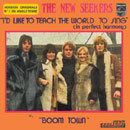
Sheet music for
the New Seekers' number 1 hit
I'd Like To Teach The World To Sing (In Perfect Harmony).
 
Following this success, an album is released in March entitled We'd Like To Teach The World To Sing (Polydor 2383 103). The album makes its chart début on 1st April, spends 25 weeks in the Top 50 and gets as high as number 2. Lyn takes the lead vocal on just one of the tracks - a Paul Williams' song entitled Just An Old Fashioned Love Song.
On 25th March the New Seekers represent the UK in the Eurovision Song Contest with the song Beg, Steal Or Borrow (Polydor 2058 201). The song comes second with a score of 114 points and the single reaches number 2 in the UK charts. On 24th April, when the New Seekers make their first appearance at the Royal Albert Hall, Eve Graham jokes about it:
"The song that we're going to sing now has done quite well for us in the British charts and we're also pleased to say that it's doing well in the charts in Europe even though it didn't win a certain contest!"

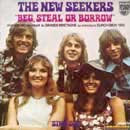
Sheet music for
the New Seekers' Eurovision hit
Beg, Steal Or Borrow.
Up until now Eve had performed the lead vocal on all but one of the New Seekers' singles. This time Lyn shares the lead vocal with Peter Doyle.
The concert at the Royal Albert Hall is one of the highlights of the New Seekers' second tour of the UK, which they embark on almost immediately after performing at Edinburgh's Usher Hall in the Eurovision Song Contest. The concert is recorded for television and years later is released as a video. An album of the concert, Live At The Royal Albert Hall (Polydor 2657 010), is released in time for Christmas. It features Lyn singing two solos - the ballad I'll Be Home and the crowd-rousing I'm A Nut. She shares the spotlight with Peter Doyle on two other songs - When I Was Small and Beg, Steal Or Borrow.
Such is the New Seekers popularity at this point in their career that Polydor Records re-release the group's last album for Philips. In June Beautiful People reappears in the shops with the title Never Ending Song Of Love (Polydor 2383 126). Meanwhile the New Seekers are voted the world's top vocal group by readers of Record Mirror and also receive a Carl-Alan award from the Duke and Duchess of Kent.
Lyn, Eve, Peter, Paul & Marty spend most of the year travelling back and forth between the UK and the States. One of their trips to the USA is spent recording material for a five-week TV series, The Ken Berry 'Wow' Show (ABC, 15th July - 12th August). The show is broadcast on Saturday mornings between 10.00am - 11.00am. It features song and dance numbers and comedy sketches lampooning popular films and TV series. Amongst the other regulars on the show are some "names in the making": Teri Garr (who went on to greater success in films such as The Conversation, Young Frankenstein and Tootsie); Cheryl Ladd (then Cheryl Stopelmoor who found fame as Farrah Fawcett's replacement on Charlie's Angels); and Steve Martin (whose many hit films include All Of Me, Roxanne, Dirty Rotten Scoundrels and Father Of The Bride).
The New Seekers' Summer TV appearances in the UK include The New Seekers at the Royal Albert Hall, a programme featuring highlights from group's concert on 24th April (BBC1, Sunday, 23rd July, 7.25pm), and a guest appearance on Saturday Variety (ITV, Saturday, 12th August, 8.30pm).
During the Summer the New Seekers also cram in a cabaret tour of the north of England and a three week residence at the Talk Of The Town. Before returning to the States again, they squeeze in a short concert tour of Germany, including sell-out dates in Frankfurt, Hamburg, Kiel and Munich.
A new single, Circles (Polydor 2058 242), enters the UK chart on 10th June. The song is credited to the pen of Harry Chapin, a singer-songwriter from the USA, who would go on to have hits under his own name in 1974 with W.O.L.D. and Cats In The Cradle (US number 1). Circles gets to number 4 in the UK and spends 16 weeks on the singles chart.
An album, also entitled Circles (Polydor 2442 102), is released in September. Lyn takes the lead vocal on two tracks - Todd Rundgren's I Saw The Light and Neil Diamond's Song Sung Blue. Neil Diamond's version of Song Sung Blue had been a UK hit in May 1972. Todd Rundgren's version of I Saw The Light wasn't to be a hit until June 1973, when it would reach number 36 in the UK chart.
In October the New Seekers take part in the BBC's 50th anniversary celebrations by recording a TV special titled Fifty Years Of Music. Others appearing on the show include Lulu, who gets things under way with a selection of songs from the 1920s and Henry Hall, who with the help of the Alyn Ainsworth Orchestra, recalls the big band sound of the 1930s. Vera Lynn and Cliff Richard perform songs from the decades with which they are most associated (the 1940s and 1960s respectively) while Gilbert O'Sullivan covers the 1970s. The New Seekers sing Smile, originally a hit for Nat 'King' Cole in 1954, followed by a medley of other songs from the 1950s - Teresa Brewer's Music Music Music ("Put another nickel in / In the nickelodeon..."), The Everly Brothers' Bye Bye Love, Catch A Falling Star and Magic Moments (both hits for Perry Como in 1958) and Scarlet Ribbons. The latter, which was a hit for Harry Belafonte in 1957, features Lyn Paul on lead vocal. The programme is screened on BBC2 on 6th November at 8.50pm. After recording their appearance the New Seekers fly back to America for a concert in Hollywood and another at the Forum, where they co-star with Bill Cosby, José Feliciano and Dionne Warwick.
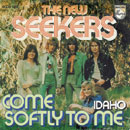
In November, while the New Seekers tour Australia and New Zealand, a single is released titled Come Softly To Me (Polydor 2058 315 / MGM MV 10698). The song was originally recorded in 1959 by the The Fleetwoods (London HL 8841). The New Seekers' version, which features Marty Kristian on lead vocal, enters the UK singles chart on 2nd December. The group promotes the single with TV appearances on both sides of the Atlantic: in the UK the New Seekers appear on Top Of The Pops and The Golden Shot; In the USA the group performs the song on The Sonny & Cher Comedy Hour (CBS, Friday, 17th November, 8.00pm).
Come Softly To Me is the New Seekers' fifth UK Top 20 hit and marks the end of a hugely successful year on the UK singles charts. At the final count, the group's singles had amassed a total of 53 weeks on the charts, placing them second only to T. Rex (58 weeks) and well ahead of artists like David Cassidy, Donny Osmond, Michael Jackson, Slade and Sweet.
Meanwhile, in the USA an album of poems and songs for children titled Free To Be... You And Me is released at the end of November, credited to Marlo Thomas & Friends. Conceived and created by the actress, author and social activist Marlo Thomas, the album challenged gender stereotypes and told children - whether boys or girls - that they were free to be whoever they wanted to be. The album would go on to become a gold record and then a television special, while the title track performed by the New Seekers would become an anthem for a generation of American children.
On Sunday, 17th December the New Seekers perform a special Christmas concert at the Hammersmith Palais for members of their Fan Club. The show is compered by DJ Ed Stewart. 8,000 people turn up and there is pandemonium as the group are mobbed by hysterical fans. Recalling scenes such as this in an interview 33 years later, Lyn said:
"Normally the groups that were being screamed at... were all male. But we were the very first mixed group with two females in it that had all this adulation... It was something to behold, I tell you, all these thousands of people outside hotels, actually breaking doors down to try and get to you. It was quite frightening at times but it was still a great thing to go through." (Flashback, BBC Radio Leeds, 14th August 2005)
One of Lyn's most vivid memories is the hysteria just after the Eurovision Song Contest.
"We were staying at the Caledonian in Edinburgh during the Eurovision and they had swing doors... They saw us in the foyer and actually broke through the swing doors to try and get to us." (Flashback, BBC Radio Leeds, 14th August 2005)
On Christmas Day the group escape the "Seeker fever" in the UK by flying to America for a season at Disneyland. Meanwhile, on 27th December there is a repeat showing of the New Seekers appearance on Fifty Years Of Music (BBC1, 5.45pm).

New Seekers
Pictured (left to right): Peter Doyle, Lyn Paul,
Eve Graham, Marty Kristian and Paul Layton
during rehearsals for the
Grand Gala du Disque Populaire,
24th February 1972.

Photo from: Nationaal Archief, Den Haag, Rijksfotoarchief.
This work is licensed under a
Creative Commons Attribution-NonCommercial-ShareAlike 4.0 International License.
Incidentally...
In January, while the New Seekers were topping the UK charts with I'd Like To Teach The World To Sing, the writers of the song, Roger Cook and Roger Greenaway, were simultaneously having Top 10 hits with Softly Whispering I Love You by the Congregation and Something Tells Me Something's Gonna Happen Tonight by Cilla Black.
On 11th February a new series of The Liver Birds begins on BBC1. The New Seekers' music features in three episodes: in the first episode Beryl (played by Polly James) sings a burst of I'd Like To Teach The World To Sing while she's in the bathroom; in episode 4 I'd Like To Teach The World To Sing is played in the background while Sandra and Beryl are at work; and in episode 10 a snatch of Beg, Steal Or Borrow can be heard in the background while they're at work.
Series 3, Episode 1: One's A Crowd
Written by: Carla Lane
(BBC1, Friday, 11th February, 7.40pm).
Series 3, Episode 4: Birds On Strike
Written by: Jack Seddok and David Pursall
(BBC1, Friday, 3rd March, 7.40pm).
Series 3, Episode 10: Birds In The Club
Written by: Jack Seddok and David Pursall
(BBC1, Friday, 14th April, 7.40pm).
The annual Ivor Novello Awards ceremony, organised by the Songwriters' Guild of Great Britain, takes place on 28th June. 'British Songwriters of the Year' for the second year running are Roger Cook and Roger Greenaway, who co-wrote I'd Like To Teach The World To Sing.
In August the six-piece band Sunshine releases its first and only album, titled Sunshine (Warner Bros. Records, K 46169). The band members are: Gordon Edwards and Jack Green, who wrote or co-wrote all of the songs on the album; vocalists Ethel Coley and Joanne White; Terry Slade (percussion) and Peter Oliver (guitar and vocals). Neither the album, nor the single taken from it, When Will I See The Light, make any impression on the pop charts. Within the space of a year, however, Peter Oliver will replace Peter Doyle as a member of the New Seekers and find himself having the chart success that eluded him while he was a member of Sunshine.
On Saturday, 30th September the painter Terence Cuneo is the guest castaway on BBC Radio 4's Desert Island Discs. One of the records he chooses to take with him to the desert island is the New Seekers' I'd Like To Teach The World To Sing.

| In the News - 1972 |
| |
|
| Jan |
The French actor and singer Maurice Chevalier dies on 1st January, aged 83.
On the same day Kurt Waldheim of Austria becomes the fourth Secretary General of the United Nations.
On 7th January US President Richard Nixon announces his intention to run for re-election in November.
The former Cunard liner Queen Elizabeth is badly damaged by fire in Hong Kong harbour on Sunday, 9th January.
On the same day 280,000 UK coal-miners begin a national seven-week strike, following the failure of pay negotiations with the National Coal Board.
Ras al-Khaimah joins the United Arab Emirates on 10th January.
Sheikh Mujibur Rahman, who had been freed from prison by the newly-elected President of Pakistan, Zulfikar Ali Bhutto, is sworn in as Prime Minister of Bangladesh on 12th January.
King Frederick IX of Denmark dies on 14th January, aged 72. Princess Margrethe is proclaimed Queen.
On 20th January the Prime Minister Edward Heath announces that unemployment in the UK had passed the 1 million mark for the first time since the 1930s.
On 22nd January in Brussels Edward Heath, Sir Alex Douglas-Home and Geoffrey Rippon sign the Treaty of Accession of the UK to the European Economic Community. Denmark, Ireland and Norway also sign the Treaty.
Shoichi Yokoi, a sergeant in the Imperial Japanese Army (IJA), is discovered in the jungles of Guam on 24th January, 28 years after the Japanese surrender, still believing that the Second World War was in progress.
The European Communities Bill is presented to the House of Commons by Geoffrey Rippon on 26th January. It narrowly passes its Second Reading on 17th February (by 309-301). MPs vote in favour of the Bill in its third and final reading (by 301-284) on 13th July.
On 26th January Sir John Addis begins his tenure as the UK's first Ambassador to the People's Republic of China.
Mahalia Jackson, "The Queen of Gospel", dies on 27th January, aged 60.
In Londonderry, Northern Ireland, British troops fire on a crowd of civil rights marchers, killing thirteen people and wounding seventeen more (a 14th man later dies of his injuries). The day on which this occurs, 30th January, becomes known as Bloody Sunday.
|
| Feb |
The British Embassy in Dublin is burnt down on 2nd February in a reprisal for Bloody Sunday.
On 4th February the UK and six other European countries officially recognise the new state of Bangladesh.
As the miners' strike takes hold, power cuts are introduced in the UK. A state of emergency is declared on 9th February. The strike is called off on Friday, 25th February after miners vote to accept a £95m pay package. The miners return to work on 28th February.
The musical Grease opens Off-Broadway at the Eden Theatre on 14th February.
President Nixon visits China, arriving in Peking on 21st February, where he is met by the Chinese Prime Minister Chou En-lai.
On 22nd February an IRA bomb explodes outside the officers' mess at the 16th Parachute Brigade headquarters in Aldershot, southern England. Six civilians are killed - five kitchen staff and an army priest - and 19 others injured.
|
| Mar |
On 1st March fourteen-year-old Timothy Davey is found guilty of trafficking hashish by a court in Istanbul. He is sentenced to six years and three months in jail.
On 4th March a hovercraft capsizes off Southsea with a loss of five lives.
A 31-year-old Royal Navy Sub-Lieutenant, David Bingham, is sentenced to 21 years in jail at Winchester Crown Court on 13th March for selling submarine defence plans to the Soviet Union for £2,800.
On 24th March the Prime Minister, Edward Heath, announces to the House of Commons that direct rule from Westminster is to be imposed on Northern Ireland. William Whitelaw is appointed Secretary of State for Northern Ireland.
On 26th March, following nine months of negotiations, Malta and the UK sign a new seven-year defence agreement.
Queen Elizabeth II opens the Treasures of Tutankhamun exhibition at the British Museum on 29th March.
On 31st March CND supporters set off on a 56-mile Easter march from London to Aldermaston, Berkshire.
|
| Apr |
On 4th April Pulsar launches the first digital watch.
On the same day the Soviet Embassy in Stockholm announces that it had refused to issue a visa to Dr. Karl Ragnar Gierow, the secretary of the Swedish Academy, who had planned to travel to Moscow to present Aleksandr Solzhenitsyn with his 1970 Nobel Prize for Literature.
On 10th April more than 5,300 people are killed by an earthquake in southern Iran.
On the same day The French Connection wins the Oscar for Best Picture at the 44th Academy Awards.
Lord Chalfont, Dr. David Owen and Dick Taverne resign from the Shadow Cabinet on 11th April.
Apollo 16 is launched from Cape Kennedy on 16th April. On 20th April the astronauts aboard the Apollo 16, Charles Duke and John Young, become the fifth team to land on the moon, despite problems the previous evening with an engine on their command module, Orion.
On 28th April it is announced that five men's Colleges at the University of Oxford - Brasenose, Hertford, Jesus, St. Catherine's and Wadham - will admit women students for the first time, beginning in 1974.
The Brighton Belle, the world's only electric all-Pullman service, makes its last journey from London Victoria to Brighton on 30th April.
|
| May |
On 9th May Israeli soldiers disguised as maintenance staff rescue 100 people on board a hijacked Sabena plane at Lod Airport in Tel Aviv.
The British cargo liner Royston Grange is destroyed by fire after a collision with a Liberian tanker in the Rio de la Plata on 11th May. All 74 passengers and crew are killed.
Alabama Governor George Wallace is shot several times and seriously wounded on 15th May in Laurel, Maryland, while campaigning for the Democratic Presidential nomination. The assassination attempt left him paralyzed from the waist down; he used a wheelchair for the rest of his life.
Ceylon becomes a republic with the new name of Sri Lanka on 22nd May.
On the same day the US President Richard Nixon begins a week-long visit to Moscow. On 26th May a treaty to halt the nuclear arms race, known as the Strategic Arms Limitation Treaty (SALT), is signed in the Kremlin by President Nixon and the Soviet leader, Leonid Brezhnev.
The Poet Laureate Cecil Day-Lewis and the actress Margaret Rutherford both die on 22nd May.
The travel company Thomas Cook & Son, which had been state-owned since 1948, is sold to a private consortium of businesses on 26th May for £22.5 million.
The Duke of Windsor dies at his home in Paris on 28th May, aged 77. Before his death, on 18th May, he had received a visit from Queen Elizabeth II, The Duke of Edinburgh and the Prince of Wales. His funeral takes place in St George's Chapel, Windsor Castle on 5th June. He is buried in the Royal Burial Ground behind the Royal Mausoleum of Queen Victoria and Prince Albert at Frogmore.
On 29th May three Japanese terrorists kill 26 people and injure more than 70 others at Lod Airport, Tel Aviv.
Five children are killed and 13 injured in a 'Big Dipper' accident at Battersea Park Fun Fair on 30th May.
|
| June |
More than 400 miners are killed in an explosion on 6th June at the Wankie Colliery in Rhodesia.
Gay News is founded. Jimmy Savile appears on the front cover of the first edition. Inside there is an article on the exclusion of the Gay Liberation Front from a recording of Savile's Speakeasy radio program, which was holding a discussion on the topic of homosexuality.
Six people are killed and 126 injured in a train accident at Eltham (Well Hall) Station on 11th June.
The Watergate burglary takes place on 17th June. Five burglars are arrested.
On 18th June 118 people aboard a BEA flight from Heathrow to Brussels are killed in Britain's worst-ever air crash. The Trident jet crashes in a field outside Staines, missing the town centre by just a few hundred metres.
Hurricane Agnes hits the coast of Florida near Panama City on 19th June, moving north to create havoc in 14 other states as well as southern parts of Ontario and Quebec in Canada. 128 people are killed and half a million are made homeless by the ensuing floods.
|
| July |
The musical Hair closes on Broadway on 1st July after 1,750 performances.
The Broadway production of Fiddler On The Roof closes on 2nd July after 3,242 performances. The show had won 9 Tony Awards in 1965, including the Tony for Best Musical.
Reginald Maudling resigns as Home Secretary on 18th July while police investigate the affairs of architect John Poulsen (Maudling had been the Chairman of one of Poulsen's companies).
79 people are killed in a head-on crash between two trains in Seville, Spain on 21st July.
In the UK on the same day five dockers are jailed by the Industrial Relations Court for refusing to obey a court order to stop picketing a container depot in Hackney.
No national newspapers are published in the UK on 24th July as print workers go on strike in support of the five jailed dockers. The 'Pentonville Five' are released from prison on 27th July following a House of Lords ruling that the TGWU is responsible for the actions of its shop stewards. On 28th July dock workers in the UK begin an official strike.
|
| Aug |
A state of emergency is proclaimed in the UK on 3rd August, giving the government special powers to ensure that essential supplies and services are maintained during the dock strike.
On Friday, 4th August, eighteen months after he had seized power, Idi Amin orders the expulsion of all Asians living in Uganda. The 50,000-strong community is given 90 days to leave.
On the same day Arthur Bremer is convicted for an assassination attempt on Alabama Governor George Wallace. He is sentenced to 63 years in prison for shooting Wallace and three other people. His sentence is reduced to 53 years on appeal.
The musical Jesus Christ Superstar, written by Andrew Lloyd Webber and Tim Rice, opens at the Palace Theatre in London on 9th August, starring Paul Nicholas as Jesus.
The last US troops leave Vietnam on 11th August.
On 16th August the Delegates Conference of the TGWU votes to end the dock strike from midnight on 20th August.
On Thursday, 22nd August the International Olympic Committee (IOC) withdraws its invitation to Rhodesia to participate in the Munich Olympics, following the threat of a boycott by African nations.
Sir Francis Chichester dies on 26th August, aged 70.
Prince William of Gloucester is killed in a plane crash on Monday, 28th August while taking part in the Goodyear International Air Trophy at Halfpenny Green, near Wolverhampton.
|
| Sep |
On 1st September the School Leaving Age in the UK is raised from 15 years to 16.
Nine Israeli athletes, who had been kidnapped from the Olympic Village in Munich by Black September terrorists, are killed on Wednesday, 6th September in a gun battle at the Fürstenfeldbruck military airbase. A policeman also dies in the shooting, along with four of the terrorists. The Olympic Games resume after a 24-hour suspension.
The Icelandic gunboat ICGV Aegir sinks two British trawlers on 12th September, triggering a second 'Cod War' between the UK and Iceland.
A 12-week strike by UK building workers comes to an end on 13th September.
A new London Underground station is opened on the Victoria Line at Pimlico on 14th September.
Dr. Ami Sachori, a diplomat at the Israeli embassy in London, is killed by a letter bomb on 19th September.
Norway votes against joining the Common Market in a referendum held on 24th and 25th September.
|
| Oct |
In a referendum held in Denmark on 2nd October a majority (63.3%) votes in favour of joining the EEC.
A service is held in Westminster Abbey on 5th October to mark the inauguration of the United Reformed Church, a union of the Congregational Church in England and Wales and the Presbyterian Church of England.
Sir John Betjeman is appointed Poet Laureate on Tuesday, 10th October, following the death of Cecil Day-Lewis.
The first episode of ITV's new twice-weekly soap opera Emmerdale Farm is broadcast on 16th October.
On 17th October Queen Elizabeth II begins a state visit to Yugoslavia, her first to a Communist country.
The European Communities Act 1972 receives Royal Assent on the same day.
The Liberal politician Cyril Smith wins the by-election held in Rochdale on 26th October. The seat had been held by Labour for 14 years.
The Osmonds fly into London on 29th October for their first-ever tour of the UK. They are greeted at Heathrow Airport by thousands of excited fans.
|
| Nov |
The US poet and literary critic Ezra Pound dies in Venice on 1st November, aged 87.
On 6th November the British government imposes Phase One of its anti-inflation programme, with a 90-day freeze on pay, prices, dividends and rents.
Richard Nixon is re-elected President of the USA on 7th November. In the elections for the US Congress Andrew Young becomes the first black American from the South to be elected since the mid-19th century.
The Queen opens the new London Stock Exchange at 125 Old Broad Street in the City of London on 8th November.
On 15th November The Queen opens the new RAF Museum at Hendon.
Juan Perón returns to Argentina on 17th November after 17 years in exile.
Israel and Syria fight an eight-hour battle on the Golan Heights on 21st November.
On 24th November Finland becomes the first Western nation to formally recognize East Germany as a separate country.
The Labour Party led by Norman Kirk wins a landslide victory in the New Zealand general election held on 25th November.
In the UK the Race Relations Act comes into force on 26th November.
On the same day Anglo-Icelandic talks on the dispute over fishing limits in waters off Iceland break down.
|
| Dec |
The Australian general election held on 2nd December is won by the Labour Party led by Gough Whitlam.
On 3rd December a charter flight to Munich (Spantax Flight 275) crashes while taking off from Tenerife Norte Los Rodeos Airport, killing all 155 on board.
Apollo 17 lands on the moon on 11th December - the sixth and last of the Apollo missions to do so.
The USA resumes full-scale bombing of North Vietnam on 18th December. Operation Linebacker II continues until 29th December.
On Friday, 22nd December fourteen people are rescued from the Andes, ten weeks after surviving a plane crash.
On Saturday, 23rd December Nicaragua is hit by an earthquake which devastates the capital Managua and kills more than 10,000 people.
Former US President Harry S. Truman dies on 26th December, aged 88.
The last issue of Life magazine is published on 29th December.
|
|
| In the Charts |
| |
UK Chart débuts |
| |
- Colin Blunstone
- David Cassidy
- Lynsey de Paul
- Electric Light Orchestra
- Roberta Flack
- Gary Glitter
- Michael Jackson
- Lindisfarne
- The Osmonds
- Roxy Music
- The Stylistics
- 10cc
- Wizzard
|
| UK Best-selling Singles |
| |
- America
A Horse With No Name
- Argent
Hold Your Head Up
- Chuck Berry
My Ding-a-Ling
- Blackfoot Sue
Standing In The Road
- Colin Blunstone
Say You Don't Mind
- David Bowie
Starman
- Carpenters
Goodbye To Love / I Won't Last A Day Without You
- Johnny Cash and The Evangel Temple Choir
A Thing Called Love
- David Cassidy
Could It Be Forever / Cherish
- David Cassidy
How Can I Be Sure
- Chelsea FC
Blue Is The Colour
- Chiffons
Sweet Talking Guy
- Chi-Lites
Have You Seen Her
- Chicory Tip
Son Of My Father
- Chiffons
Sweet Talkin' Guy
- Alice Cooper
Elected
- Alice Cooper
School's Out
- Terry Dactyl and The Dinosaurs
Seaside Shuffle
- Lynsey de Paul
Sugar Me
- Neil Diamond
Song Sung Blue
- Dr. Hook and The Medicine Show
Sylvia's Mother
- The Drifters
At The Club / Saturday Night At The Movies
- The Drifters
Come On Over To My Place
- Donnie Elbert
Where Did Our Love Go?
- Faces
Stay With Me
- Roberta Flack
The First Time Ever I Saw Your Face
- The Fortunes
Storm In A Teacup
- Gary Glitter
Rock and Roll Part 2
- Al Green
Let's Stay Together
- Hawkwind
Silver Machine
- Michael Jackson
Ain't No Sunshine
- Michael Jackson
Ben
- Michael Jackson
Got To Be There
- Michael Jackson
Rockin' Robin
- John and Yoko / the Plastic Ono Band with the Harlem Community Choir
Happy Xmas (War Is Over)
- Elton John
Crocodile Rock
- Elton John
Rocket Man
- Judge Dread
Big Seven
- Vicky Leandros
Come What May
[Eurovision Song Contest winner]
- Lieutenant Pigeon
Mouldy Old Dough
- Lindisfarne
Lady Eleanor
- Lindisfarne
Meet Me On The Corner
- Don McLean
American Pie
- Don McLean
Vincent
- Melanie
Brand New Key
- The Moody Blues
Isn't Life Strange
- Mott the Hoople
All The Young Dudes
- The Move
California Man
- Johnny Nash
I Can See Clearly Now
- Johnny Nash
There Are More Questions Than Answers
- New World
Sister Jane
- Nilsson
Without You
- Donny Osmond
Puppy Love
- Jimmy Osmond
Long Haired Lover From Liverpool
- The Osmonds
Crazy Horses
- Gilbert O'Sullivan
Alone Again (Naturally)
- Gilbert O'Sullivan
Clair
- Elvis Presley
I Just Can't Help Believing
- Neil Reid
Mother of Mine
- Cliff Richard
Living In Harmony
- The Rolling Stones
Tumbling Dice
- Roxy Music
Virginia Plain
- Royal Scots Dragoon Guards
Amazing Grace
- The Shangri-Las
Leader Of The Pack
- Paul Simon
Mother And Child Reunion
- Peter Skellern
You're A Lady
- Slade
Gudbuy T' Jane
- Slade
Mama Weer All Crazee Now
- Slade
Take Me Bak 'Ome
- Sly and The Family Stone
Family Affair
- Hurricane Smith
Oh Babe, What Would You Say
- Sonny and Cher
All I Ever Need Is You
- Ringo Starr
Back Off Boogaloo
- Cat Stevens
Morning Has Broken
- Rod Stewart
You Wear It Well
- The Supremes
Automatically Sunshine
- The Supremes
Floy Joy
- Sweet
Little Willie
- Sweet
Wig Wam Bam
- T. Rex
Metal Guru
- T. Rex
Telegram Sam
- 10cc
Donna
- Jackie Wilson
I Get The Sweetest Feeling
- Bill Withers
Lean On Me
- Neil Young
Heart Of Gold
|
| One Hit Wonders |
| |
- Roy C
Shotgun Wedding
- Hot Butter
Popcorn
- Jo Jo Gunne
Run Run Run
- Mardi Gras
Too Busy Thinking 'Bout My Baby
- Johnny Pearson Orchestra
Sleepy Shores (Theme from Owen M.D.)
- Python Lee Jackson
In A Broken Dream
- Shag (Jonathan King)
Loop Di Love
- Faron Young
It's Four In The Morning
|
| Hit Albums |

|
- David Bowie
The Rise and Fall Of Ziggy Stardust And The Spiders From Mars
- Bread
Best Of Bread
- Neil Diamond
Moods
- George Harrison and Friends
Concert For Bangladesh
- Lindisfarne
Fog On The Tyne
- Don McLean
American Pie
- The Osmonds
Crazy Horses
- The Rolling Stones
Exile On Main Street
- Paul Simon
Paul Simon
- Slade
Slayed?
- Phil Spector
Phil Spector's Christmas Album
- Cat Stevens
Catch Bull At Four
- Rod Stewart
Never A Dull Moment
- T. Rex
Bolan Boogie
- T. Rex
The Slider
- Yes
Close To The Edge
- Neil Young
Harvest
|

|
|
| At the Movies |
| |
| |
- Alice's Adventures In Wonderland
- The Boyfriend
- Cabaret
- The Candidate
- Carry On Abroad
- A Clockwork Orange
- Deliverance
- Diamonds Are Forever
- Duel
- Everything You Always Wanted To Know About Sex But Were Afraid To Ask (Woody Allen)
- The French Connection
- Frenzy
- The Godfather
- The Hospital
- Lady Caroline Lamb
- Mary, Queen Of Scots
- Play It Again Sam (Woody Allen)
- What's Up Doc?
- Young Winston
|
|
| On Stage |
| |
Tony Award for Best Musical:
The Two Gentlemen
Of Verona
|
|
| On Television |
| |
| |
- The Adventures Of Black Beauty
- Alistair Cooke's America
- Are You Being Served?
(pilot episode)
- Colditz
- Columbo
- Dad's Army
(Series 5)
- Dave Allen At Large
(Series 2)
- Doctor Who (Season 9, Jon Pertwee)
- Emmerdale Farm
- Father, Dear Father
(Series 6)
- General Hospital
- John Craven's Newsround
- The Liver Birds
(Series 3)
- Look - Mike Yarwood!
(Series 2)
- Love Thy Neighbour
(Series 1 and 2)
- M*A*S*H
(USA)
- Mastermind
- Monty Python's Flying Circus
(Series 3)
- My Wife Next Door
- On The Buses
(Series 6)
- Pebble Mill At One
- Record Breakers
- Sale Of The Century
- Shut That Door!!
(Larry Grayson)
- Steptoe And Son
(Series 7)
- Thirty Minutes Worth
(Harry Worth)
- Till Death Us Do Part
(Series 4)
- The Two Ronnies
(Series 2)
- Van Der Valk
- The Waltons
- War And Peace
- Weekend World
|
|
| Sporting Heroes |
| |
BBC Sport
BBC
Sports Personality
of the Year:
Mary Peters
|
Winter Olympics: Fernandez Ochoa wins the men's slalom and becomes the first Spaniard to win a gold medal at the Winter Olympic Games.
Tennis: Virginia Wade wins the women's singles title at the Australian Open, beating the home favourite Evonne Goolagong in the final, 6-4, 6-4. Billie Jean King wins the other three Grand Slams of 1972, beginning with two 6-3, 6-3 victories over Evonne Goolagong in the finals of the French Open and Wimbledon, followed by a 6–3, 7–5 victory over Kerry Melvill in the final of the US Open.
Ken Rosewall retains his men's singles title at the Australian Open, beating fellow Australian Mal Anderson in the final, 7-6, 6-3, 7-5.
Andrés Gimeno wins the men's singles title at the French Open, defeating Patrick Proisy in the final, 4–6, 6–3, 6–1, 6–1.
Stan Smith wins the men's singles title at Wimbledon, defeating Ilie Năstase in the final, 4-6, 6-3, 6-3, 4-6, 7-5.
After losing in five sets at Wimbledon, Ilie Năstase proceeds to win in five sets at the US Open, defeating Arthur Ashe in the men's singles final, 3–6, 6–3, 6–7 (1–5), 6–4, 6–3.
Boxing: World Heavyweight Champion Joe Frazier stops Terry Daniels in 4 rounds in New Orleans to retain his WBC and WBA titles.
Joe Bugner knocks out Jurgen Blin to regain his European Heavyweight title.
Rugby Union: the Five Nations Championship is not completed for the first time since World War II. Due to the political situation, neither Scotland nor Wales travel to Dublin to play their matches against Ireland. Although Ireland and Wales win all their other matches, neither team is allowed to claim the title.
Welsh fly-half Barry John retires, aged 27.
Snooker: Alex Higgins beats the defending Champion John Spencer in the final of the World Snooker Championship (37-32) to win the first of his two World titles.
Rowing: the University of Cambridge crew wins the annual Boat Race against Oxford for the fifth year in a row.
Horse Racing: Well To Do, ridden by Graham Thorner, wins the Grand National.
Lester Piggott, riding Roberto, wins the Derby for the sixth time.
Willie Carson becomes Champion Jockey for the first time.
Athletics: women are allowed to compete officially in the Boston Marathon for the first time. Nina Kuscsik is the first woman to cross the finish line, completing the marathon in a time of 3:10:26. The men's winner is Olavi Suomalainen, who finishes with a time of 2:15:39.
Golf: Jack Nicklaus wins both the US Masters at Augusta and the US Open at Pebble Beach, California.
Lee Trevino wins the British Open for the second year running. Jack Nicklaus is runner-up.
Football: Tommy Docherty is appointed Manager of Manchester United.
Leeds United win the 100th FA Cup Final, beating Arsenal 1-0.
Having been promoted from the Second Division in 1969, Derby County end the season as Champions of the Football League First Division for the first time in the club's history.
Glasgow Rangers win the European Cup Winners' Cup, beating Dynamo Moscow 3-0 in the final.
Cycling: Eddy Merckx wins the Tour de France for the fourth year in a row.
Olympics: the US swimmer Mark Spitz becomes the first athlete to win seven gold medals at an Olympics.
Mary Peters wins a gold medal for Britain in the Women's Pentathlon.
Chess: Bobby Fischer of the US beats Boris Spassky of the Soviet Union to become the first American world chess champion.
Motor Racing: Emerson Fittipaldi wins the Italian Grand Prix to become the youngest-ever Formula 1 World Drivers' Champion.
|
|
| Page-turners |
| |
Man Booker Prize
Winner:
John Berger
G
On the shortlist:
Susan Hill
Bird Of Night
Thomas Keneally
The Chant Of Jimmy Blacksmith
David Storey
Pasmore
|
|














.jpg)