








In print |
   |
||||||||
These pages provide details of some of the printed publications - books, theatre programmes, newspapers and magazines - that have featured Lyn Paul during her long career.
|
|||||||||


 |
Inspirations
Inspirations: original lyrics and the stories behind the greatest songs ever written
Included among the stories behind the songs is the tale of a tune that started its life as True Love and Apple Pie and ended up as I'd Like To Teach The World To Sing (page 63). |
 |
Lights, Camera,
Soundtracks
Lights, Camera, Soundtracks: The Ultimate Guide to Popular Music in the Movies
There's no mention of John Barry's soundtrack to The Dove, so Lyn Paul fans will be disappointed with this one. However, if you persevere as far as page 364, you'll find a reference to Wishful Thinking, a four-piece band featuring Danny Finn of the New Seekers. Think twice before you persevere, though. The review of the soundtrack to That'll Be The Day featuring Wishful Thinking has this to say: "But for the tracks such as fillers... It'll Be Me by Wishful Thinking (spelt with two L's on the sleeve!)... the album would have been near faultless." Ouch! |
 |
Lives Of The
Great Songs
Lives Of The Great Songs
If your local librarian hasn't already withdrawn this book from stock, you may still find it lingering on the library shelves. Jasper Rees (clearly not a fan of the New Seekers) fires a few wayward shots at the group in his article about Bob Dylan's Blowin' In The Wind (pages 101-102). "No one," he claims, "plumbed the depths quite like the New Seekers... Their version, elaborating on the more restrained example of The Seekers, is a happy-clappy sing-along with a ghastly guitar break." |
 |
The Long-Player
Goodbye
The Long-Player Goodbye: The Album From Vinyl To iPod And Back Again
No need to find space on your bookshelves for this one. The New Seekers are mentioned once (page 332) and only in passing. In a chapter covering the rise of punk, the author writes: "And illustrating the other rather dismal stuff people were into then [1976], the remaining live music picks of that week were Gallagher and Lyle, the New Seekers and Hall and Oates... " |
Music: Over a Century of the Greatest Artists, Albums, Songs, Performances and Events That Rocked the Music World
An encyclopaedia covering 100 years of popular music, decade by decade. I'd Like To Teach The World To Sing by the New Seekers is featured as a 'Key Song' of the decade 1970-79 (page 405), while the writers of the song, Roger Cook and Roger Greenaway, are featured as 'Key People' (page 427). |

Music (The Little Black Book)
 |
The Music
Goes Round
My Head
The Music Goes Round My Head: Australian pop music 1964-1969
All you'll ever need to know about Australian pop and rock in the mid to late 1960s. The book includes information about Peter Doyle, Mick Flinn and Marty Kristian. |
 |
MTV
Pop and Rock
World Records
2011
MTV Pop and Rock World Records 2011
Turn to page 36 for the best-selling singles by year in the UK: the New Seekers' singles I'd Like To Teach The World To Sing and You Won't Find Another Fool Like Me are listed as the top-selling singles of 1972 and 1974 respectively. |
 |
1971
Never A Dull Moment:
Rock's Golden Year
1971 - Never A Dull Moment: Rock's Golden Year
The New Seekers are mentioned in passing in the chapter November: Hunky Dory (page 300). |
100 Greatest Australian Singles Of The '60s
Australia's 100 greatest singles of the 1960s as chosen by David N. Pepperell and Colin Talbot. There's a page devoted to each of the singles with a picture of the recording artists on the facing page. |

100 Greatest Australian Singles Of The '60s
 |
Rough Guide To
Cult Pop
The Rough Guide To Cult Pop
A pocket-sized pop trivia book that gives a brief nod in the direction of the New Seekers (page 329). The last section, The Final Countdown, makes an interesting link between the group's 1971 single I'd Like To Teach The World To Sing and The Kinks' 1970 hit Lola. Although the New Seekers' hit was easily identifiable as the tune from a Coca-Cola commercial, it was the lyrics of the latter which mentioned the drink by name, necessitating a change to "cherry cola" to prevent the song from being banned by the BBC! |
 |
Runs In The Blood
| WEB LINKS MarcieJones .com |
Runs In The Blood
This is the biography of Australian singer Marcie Jones. It includes her memories of the Sunshine days in the '60s when she appeared on The Go!! Show and toured Australia with Peter Doyle and the other artists on the Sunshine label. Among her many memories Marcie recalls the Sounds Of '64 concert at the Palais Theatre, St. Kilda (page 99) and the sixties revival concert in 1997, which featured Peter Doyle, Rob Lovell and Danny Robinson re-united as the Virgil Brothers and Peter Doyle performing solo - "everyone could still cut it and we all had a ball." |
 |
Tapestry Of Delights
Tapestry Of Delights: comprehensive guide to British music of the Beat, R&B, Psychedelic and Progressive eras, 1963-76
Tapestry Of Delights is an encyclopaedic guide to British music of the Beat, R&B, Psychedelic and Progressive eras, 1963-76, described by Q magazine as an "impressive 600 page job, that includes more across-the-board info than most rock encyclopaedias". It includes information on Brian Engel's group Mandrake Paddlesteamer. |
Tapestry Of Delights: Revisited
A revised and updated edition of Tapestry Of Delights, featuring information on The Nocturnes (page 615), Mandrake Paddlesteamer (page 532) and Wishful Thinking (page 938). Many of the entries have been rewritten, more have been added, and all have been updated to include relevant releases since 1995. |
 |
Thirty Years Of
Number 1s
Thirty Years Of Number 1s:
A year by year guide to the chart-toppers on both sides of the Atlantic covering the years 1960-89. The commentary on the year 1972 includes a paragraph about the New Seekers (page 64). The original Seekers are featured in the commentary on 1965 (page 32). |
 |
Top Of The Pops
50th
Anniversary
| WEB LINKS Google ebook: Top Of The Pops 50th Anniversary |
Top Of The Pops 50th Anniversary
A history of Top Of The Pops, which recalled "pop-tastic hits from Pickettywitch, Mungo Jerry, New Seekers and the Poppy Family" (page 44). Anecdotes include Sue Menhenick's memories of dancing to You Won't Find Another Fool Like Me with Pan’s People (page 46) and DJ Ed Stewart's recollection of the episode where he had to wear an eye patch: |
 |
Top Pop Singles
| WEB LINKS Record Research |
Top Pop Singles, 1955-1999
An encyclopaedic guide to the US singles chart from 1955-99. It gives details of all the New Seekers' hits on the Billboard Top 100. |
Volume 2 of a comprehensive guide to the Van Dike club in Plymoth, which closed its doors in July 1972. It contains a photo of Eve Graham with Chris Davis and another of Lyn Paul, also with Chris Davis. If you look closely at the photo of Eve and Chris, you'll notice that there's a photo of Lyn hanging on the wall behind them. |
 Van Dike, More Life & Times Of a Plymouth Club 1968-1980
  |
We Could Have Been
The Wombles
We Could Have Been The Wombles
'We Could Have Been The Wombles' takes a humourous look at the chart phenomenon known as the 'one hit wonder' (it was originally published in 2004 with the title 'The One and Only'). Books like this often turn out to be tedious - 'anoraks only' lists of little-known and best-forgotten facts - but this one isn't. It's the sort of book that you can dip into as the fancy takes you, but when you do put it down you'll probably find it's not long before you pick it up again. It's almost addictive - or maybe the anorak is getting too comfy? |
 |
The Who
And The Making Of
Tommy
The Who And The Making Of Tommy
Volume 5 of the Vinyl Frontier series takes an in-depth look at the Who's album Tommy, tracing its origins and evolution as a recording, live performance, movie and musical. The New Seekers are mentioned on page 159. |
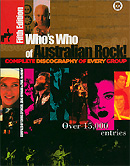 |
Who's Who Of
Australian Rock!
Who's Who Of Australian Rock!
An encyclopedia giving basic information about the recordings of Australian bands and solo artists. It includes entries for three of the New Seekers - Peter Doyle, who is listed both as a solo artist and as a member of the Virgil Brothers, Marty Kristian and Mick Flinn (listed as a member of The Mixtures and the Wild Colonials). < Previous page | Next page [Nostalgia] > |

021118
Last amended:
231110
Top of page | Home page | Index | Search | Site Map | E-mail
Now... | Then... | New Seekers | On Disc | In Print | On the Net | Photo Album
URL: http://www.lynpaulwebsite.org
E-mail: lynpaulwebsite@hotmail.com
Copyright © 1999-2026, Steven Liddle